
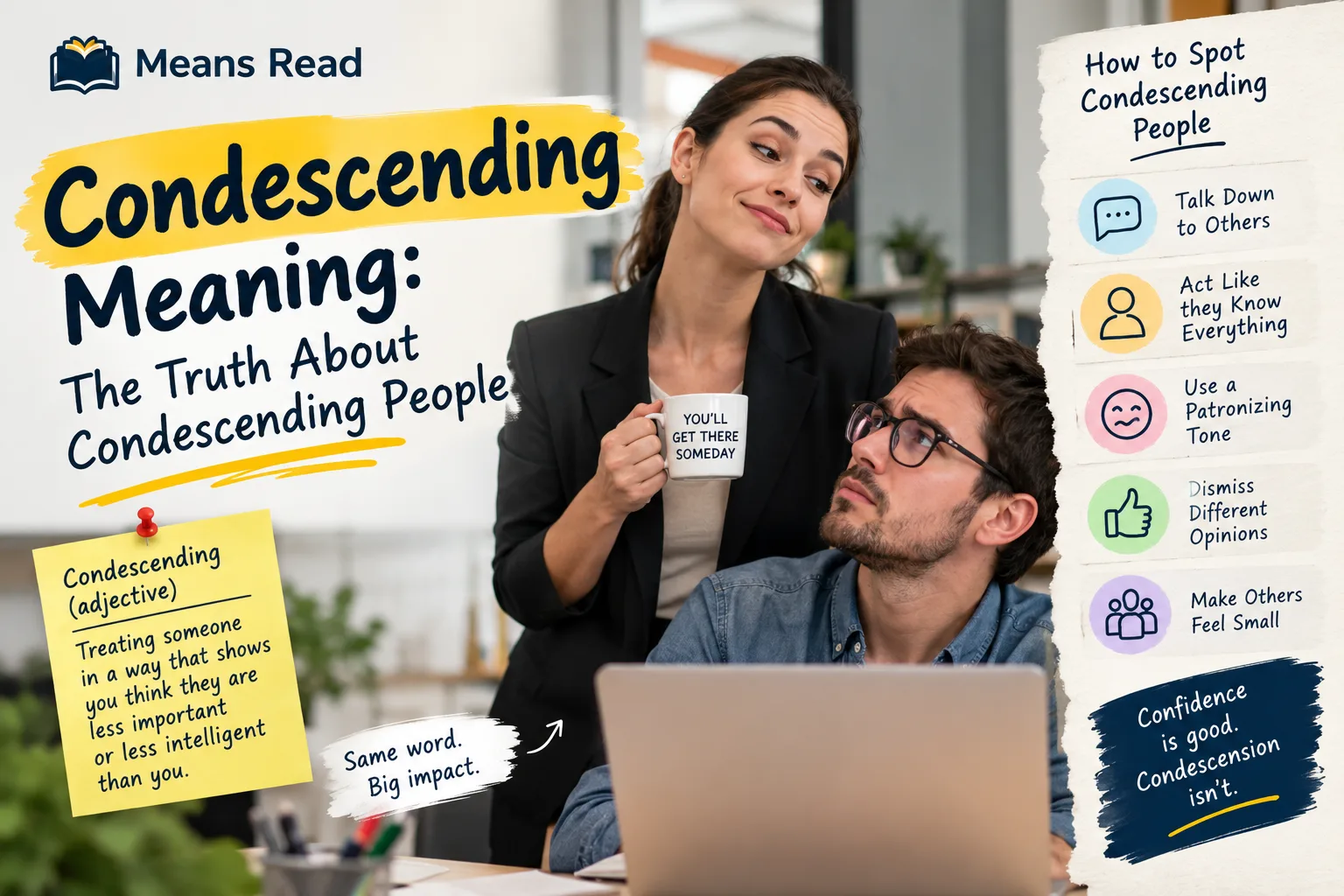
Condescending meaning describes behavior or a tone that shows you believe you are smarter, more important, or somehow above the other person. When someone is condescending, they talk down to you as if you need things explained in simple terms or as if your opinions matter less. It is almost always experienced as insulting, even when the speaker claims they are “just trying to help.”
Americans use the word constantly in workplaces, family conversations, online comments, and everyday interactions. “That was so condescending.” “Don’t talk to me in that condescending tone.” The complaint is rarely about the information itself. It is about the attitude that comes with it.
This article explains condescending meaning in English with clear examples, compares it to the closely related word “patronizing,” shows how it looks in real life, and offers practical ways to recognize and respond to it.
Condescending Meaning in Simple Terms
At its core, condescending meaning is an attitude of superiority expressed through words, tone, or body language. The speaker acts as if they are descending from a higher position to deal with someone less capable.
Classic signs include:
- Explaining something the other person already understands, in a slow or overly simplified way
- Using a tone that sounds like speaking to a child
- Offering “helpful” comments that actually highlight the other person’s supposed shortcomings
- Smiling or nodding in a way that feels dismissive rather than genuine
The behavior does not require open insults. The superiority is often delivered with a polite surface that makes it harder to call out directly.
Condescending Meaning and Examples
Here are everyday American examples that illustrate condescending meaning and examples:
- A coworker says, “Let me explain this in a way you’ll understand,” then proceeds to restate something basic you already know.
- A relative responds to your career update with, “That’s nice, dear. At least you’re trying.”
- Someone on a group project comments, “I wouldn’t expect you to know this, but…”
- A customer-service agent uses an exaggeratedly patient voice after you ask a reasonable question.
- Online: “Actually…” followed by a correction delivered with unnecessary flourish.
In each case the content might be factually correct. The delivery communicates “I am above you.”
Rude and Condescending Meaning
Rude and condescending behavior combines general disrespect with an extra layer of superiority. Ordinary rudeness can be blunt or abrupt. Condescension adds the implication that the other person is lesser. That combination often feels more personal and harder to shake off because it attacks competence or status rather than just manners.
People frequently describe the experience as “being talked down to” or “being treated like a child.” The emotional impact is usually stronger than a simple rude remark because it questions the listener’s intelligence or worth.
Patronizing vs Condescending Meaning
Many people search for patronizing vs condescending meaning because the two words overlap heavily and are often used interchangeably. Both involve treating someone as inferior. The subtle difference lies in flavor:
| Aspect | Condescending | Patronizing |
|---|---|---|
| Core feeling | Superiority and talking down | Superiority mixed with false kindness or “help” |
| Typical delivery | Tone, explanations, attitude | Helpful-sounding comments that still diminish the other |
| Common perception | More openly superior | Often disguised as concern or guidance |
| Example | “Obviously you wouldn’t know this…” | “I’m sure you’re doing your best, sweetie…” |
In practice, most Americans treat them as near-synonyms. If someone says “Don’t patronize me” or “That was condescending,” they are usually reacting to the same underlying experience of being treated as less capable.
Condescending Meaning for Kids
When explaining condescending meaning for kids, keep it concrete and age-appropriate:
Being condescending means acting like you are better or smarter than someone else and talking to them in a way that makes them feel small. It is like an older kid saying to a younger one, “You wouldn’t understand because you’re just a little kid,” even when the younger child is perfectly capable of understanding.
Kids often recognize the feeling before they know the word. Teaching them the label helps them name the experience and decide how to respond—whether by speaking up, walking away, or telling a trusted adult.
Condescending Meaning Synonyms
Useful condescending meaning synonyms include:
- Patronizing
- Superior
- Arrogant
- Disdainful
- Supercilious
- Snobbish
- Haughty
- Snooty (informal)
- Talking down to someone
Each carries a slightly different shade, but all point to an attitude that places the speaker above the listener.
How Condescension Shows Up in American Life
At work
A manager or senior colleague uses a patient, simplified tone that implies the junior person is slow. Team members may feel undermined even when the advice is correct.
In families
Older relatives sometimes slip into condescending language when discussing younger people’s choices about careers, relationships, or money. The intent may be protective; the effect is often alienating.
Online
Comment sections and social media are full of “Actually…” replies and explanations that assume the original poster is uninformed. The public nature of the exchange amplifies the sting.
In customer service or professional settings
An expert explains something with exaggerated patience or a slightly amused smile. The customer or client leaves feeling talked down to rather than helped.
How to Respond When Someone Is Condescending
Clear, calm responses often work better than matching the tone:
- “I understand the point. You don’t need to simplify it for me.”
- “I’m familiar with this. Let’s move to the next step.”
- “That tone isn’t necessary. Can we keep this straightforward?”
If the pattern is repeated with the same person, a private conversation naming the behavior can sometimes reset the dynamic. In ongoing relationships or workplaces, documenting patterns and seeking support from HR or a trusted third party may become necessary.
How to Avoid Sounding Condescending Yourself
Most people do not set out to be condescending. Common traps include:
- Over-explaining when the other person already understands
- Using a slower or higher-pitched voice without realizing it
- Adding unnecessary qualifiers like “as I’m sure you know” or “just so we’re clear”
- Offering unsolicited advice in a way that assumes incompetence
A useful self-check: Would I say this the same way to a peer I respect as an equal? If the answer is no, adjust the delivery.
Condescending Meaning in Farsi
For readers looking for condescending meaning in Farsi, approximate equivalents include phrases that convey speaking from a position of superiority or looking down on someone, such as از بالا به پایین حرف زدن or خودبرتربینانه. Context determines the most natural rendering, and native speakers or specialized dictionaries remain the best sources for precise usage.
Read More:
TLDR Meaning
Antebellum Meaning
TMP Meaning
What Does HN Mean in Text?
Skink Meaning
Naive Meaning
Platonic Meaning
Pedantic Meaning
Why the Word Matters
Condescending meaning names a specific social injury: the experience of being treated as less intelligent or less important. Having a clear word for it helps people recognize the pattern, set boundaries, and choose more respectful ways of communicating. In a culture that values equality and competence, the ability to speak without talking down to others is both a social skill and a form of basic respect.
