
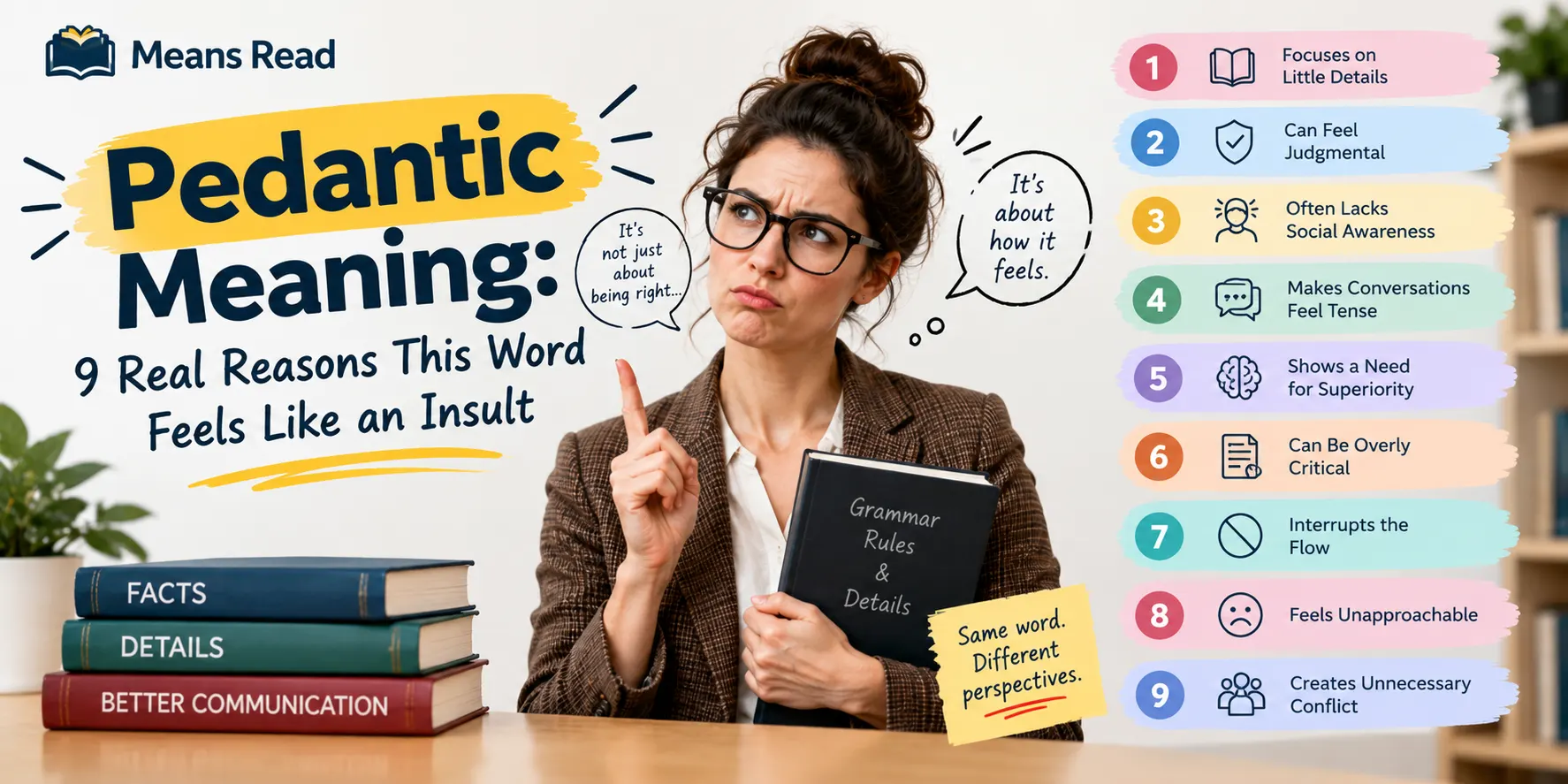
Pedantic meaning is one of those words Americans reach for when someone crosses the line from careful to irritating. You hear it in offices, group chats, family dinners, and Twitter replies. When someone says “You’re being pedantic,” they rarely mean it as a compliment. They mean the other person is focusing too hard on small details, rules, or correct facts in a way that feels unnecessary, show-offy, or conversation-killing.
This article breaks down the full pedantic meaning the way real people in the United States use it today. You’ll see clear definitions, everyday American examples, the difference between helpful precision and annoying pedantry, how the trait shows up in relationships and workplaces, and practical ways to deal with it — whether you’re on the receiving end or you suspect you might be the one doing it.
What Does Pedantic Meaning Actually Mean?
At its simplest, pedantic meaning describes someone who is overly concerned with minor details, formal rules, or displaying knowledge in a way that feels tiresome. The word almost always carries a disapproving tone.
Merriam-Webster defines pedantic as “of, relating to, or being a pedant” and explains a pedant as a person who “annoys others by correcting small errors” or who is “narrowly, stodgily, and often ostentatiously scholarly.” Cambridge Dictionary puts it as “giving too much attention to formal rules or small details.” Oxford Learner’s Dictionary calls it “too worried about small details or rules.”
In plain American English: a pedantic person cares more about being precisely right on tiny points than about whether the point actually matters in the moment.
The Origin of Pedantic Meaning
The story behind pedantic meaning starts with schoolteachers. In the late 1500s, the English word “pedant” came from French and Italian terms that simply meant schoolmaster or teacher. At first it was neutral. By the early 1600s, the meaning had already shifted. People began using “pedant” and then “pedantic” for teachers (and later anyone) who were rigid, showy about their learning, or obsessed with tiny rules and formalities.
That negative flavor stuck. Today when Americans use the word, they are almost never talking about a helpful teacher. They are talking about someone who uses knowledge or rules to correct, dominate, or look superior in everyday situations.
9 Clear Signs Someone Is Being Pedantic
Here are the most common ways pedantic meaning shows up in real American life:
- Correcting small factual errors that do not change the overall point of a story.
- Insisting on the “proper” pronunciation of a word or name even when everyone understood it.
- Focusing on grammar or punctuation in informal texts, emails, or social media posts.
- Quoting obscure rules or technical definitions in casual conversation.
- Turning a light discussion into a mini-lecture about accuracy.
- Pointing out minor inconsistencies while ignoring the bigger picture.
- Using specialized vocabulary when simpler words would work fine.
- Feeling the need to prove they know more than others on topics that are not currently relevant.
- Getting visibly irritated when other people are “imprecise.”
Any one of these can be occasional and harmless. When several become a regular pattern, people start reaching for the word pedantic.
Pedantic Meaning in Everyday American Situations
At work
Someone sends a quick Slack message about a project deadline. A pedantic coworker replies with a correction about the exact time zone abbreviation or a minor formatting issue in the original message. The actual deadline discussion gets delayed.
In relationships and friendships
A partner tells a story about what happened at a restaurant. The other person interrupts to correct the name of the street or the exact year the place opened. The emotional point of the story is lost.
On social media
Someone posts an opinion or a rough summary of an event. A pedantic commenter replies only to fix a small factual detail or a grammar slip, often with a tone that suggests superiority.
In family conversations
A relative is telling a childhood memory. Another relative jumps in with “Actually, it was 1987, not 1986” and then proceeds to list other small corrections. The original story never recovers its momentum.
These moments feel different from genuine helpfulness because the correction does not improve understanding or solve a problem. It mainly shows that the speaker noticed something others missed.
Pedantic vs. Meticulous, Nitpicky, Didactic, and Precise
Americans often mix these words up. Here’s a practical breakdown of how pedantic meaning differs from close relatives:
- Meticulous is usually positive. It means careful, thorough, and detail-oriented in a useful way. A meticulous editor catches real errors that matter. A pedantic person catches errors that mostly matter to them.
- Nitpicky is close to pedantic but often feels smaller and more personal. Nitpicking focuses on tiny flaws. Pedantic behavior often involves knowledge or rules and can feel more intellectual.
- Didactic means intended to teach. It can be neutral or slightly negative when the teaching feels preachy. Pedantic is almost always negative and focuses more on correctness than on teaching a useful lesson.
- Precise is generally positive. Precision helps clarity. Pedantry uses precision in situations where approximate understanding would have been fine.
The difference is rarely about whether details matter. It is about whether the attention to detail serves the conversation or serves the speaker’s need to be right.
When Pedantic Behavior Is Actually Useful
Not every instance of high attention to detail deserves the label. In certain American professional and practical contexts, the same traits become strengths:
- Legal writing and contract review
- Medical instructions and dosage information
- Engineering, coding, and safety-critical work
- Financial reporting and tax documents
- Academic research that requires exact citations
- Fact-checking for journalism or public records
In these areas, people rarely call careful work “pedantic.” They call it professional, thorough, or rigorous. The negative label appears when the same energy is applied to situations that do not require it.
The Personality Side of Pedantic Meaning
Some people show Pedantic Meaning tendencies across many areas of life. Others only become pedantic in specific domains — language, history, their own job, or topics they feel expert in. Common underlying drivers include:
- A strong need for order and predictability
- Anxiety about looking uninformed
- Habit from academic or technical training
- Desire to feel competent or superior in conversation
- Difficulty reading social cues about when accuracy is welcome
In relationships this can create real friction. The partner or friend who is constantly corrected starts editing themselves, sharing less, or feeling judged. Over time the relationship can feel less safe even if both people care about each other.
How Americans Talk About Pedantic People
In everyday U.S. speech you will hear phrases such as:
- “He’s being so pedantic right now.”
- “Don’t be pedantic — you know what I meant.”
- “That reply was pure pedantry.”
- “She’s brilliant but can get really pedantic in meetings.”
People also use softer versions: “a bit of a stickler,” “kind of a grammar cop,” or “one of those people who has to correct everything.”
Practical Ways to Deal With Pedantic Behavior
If you are on the receiving end:
- Decide whether the correction actually matters. If it does not, you can simply say “Thanks” and continue.
- In ongoing relationships, a calm boundary helps: “I get that the detail is important to you, but right now I’m just trying to tell the story.”
- In work settings, redirect to the goal: “The exact wording is noted. Can we focus on the deadline?”
If you suspect you might be the pedantic one:
- Pause before correcting and ask: “Does this change anything important?”
- Offer corrections privately when possible.
- Practice letting small inaccuracies slide in casual conversation.
- Notice the other person’s face and energy. Frustration or shutdown is usually a signal to stop.
Many people who lean pedantic are not trying to dominate. They simply value accuracy highly and have not calibrated when that value is welcome.
Pedantic Meaning in Online Culture
American internet culture has made the word more common. Grammar corrections in comment sections, “actually” replies on Reddit or X, and long threads correcting minor details in news posts are frequent targets for the label. At the same time, some online communities value high precision (certain technical forums, legal discussion spaces, or scientific communities). Context still decides whether the behavior is seen as useful or Pedantic Meaning.
Synonyms and Related Words Americans Actually Use
Common near-synonyms and related terms include:
- Nitpicky
- Stickler
- Fussy
- Overly precise
- Schoolmarmish (somewhat dated)
- Hair-splitting
- Dogmatic about details
- Ostentatiously learned
Antonyms or contrasting ideas include easygoing, flexible, big-picture oriented, and laid-back about minor details.
A Quick Self-Check
Ask yourself these questions the next time you feel the urge to correct someone:
- Will this correction improve understanding or just prove I noticed something?
- Is the conversation formal or casual?
- Does the other person seem open to the information right now?
- Am I correcting because the detail matters or because I dislike imprecision?
Honest answers to these questions usually reveal whether you are being helpful or crossing into pedantic territory.
Why Understanding Pedantic Meaning Matters
Language gives us tools to name social friction. Pedantic meaning exists because people repeatedly experience the difference between useful care and unnecessary exactness. Knowing the word helps you recognize the pattern, talk about it without excessive drama, and decide how you want to show up in conversations.
In a culture that values both intelligence and social ease, the ability to be accurate without being pedantic is a genuine social skill. Precision remains valuable. Timing and proportion decide whether that precision helps or hinders.
Read More:
TLDR Meaning
Antebellum Meaning
TMP Meaning
What Does HN Mean in Text?
Skink Meaning
Naive Meaning
Platonic Meaning
Final Thoughts on Pedantic Meaning
Pedantic meaning is not complicated once you see it in action. It describes the moment when attention to small details or rules stops serving the conversation and starts serving the speaker’s need to be right or to display knowledge. Americans use the word because the behavior is common and recognizable. Understanding it gives you clearer language for everyday friction at work, at home, and online — and a practical way to decide when accuracy is worth the interruption and when it is better left alone.
