
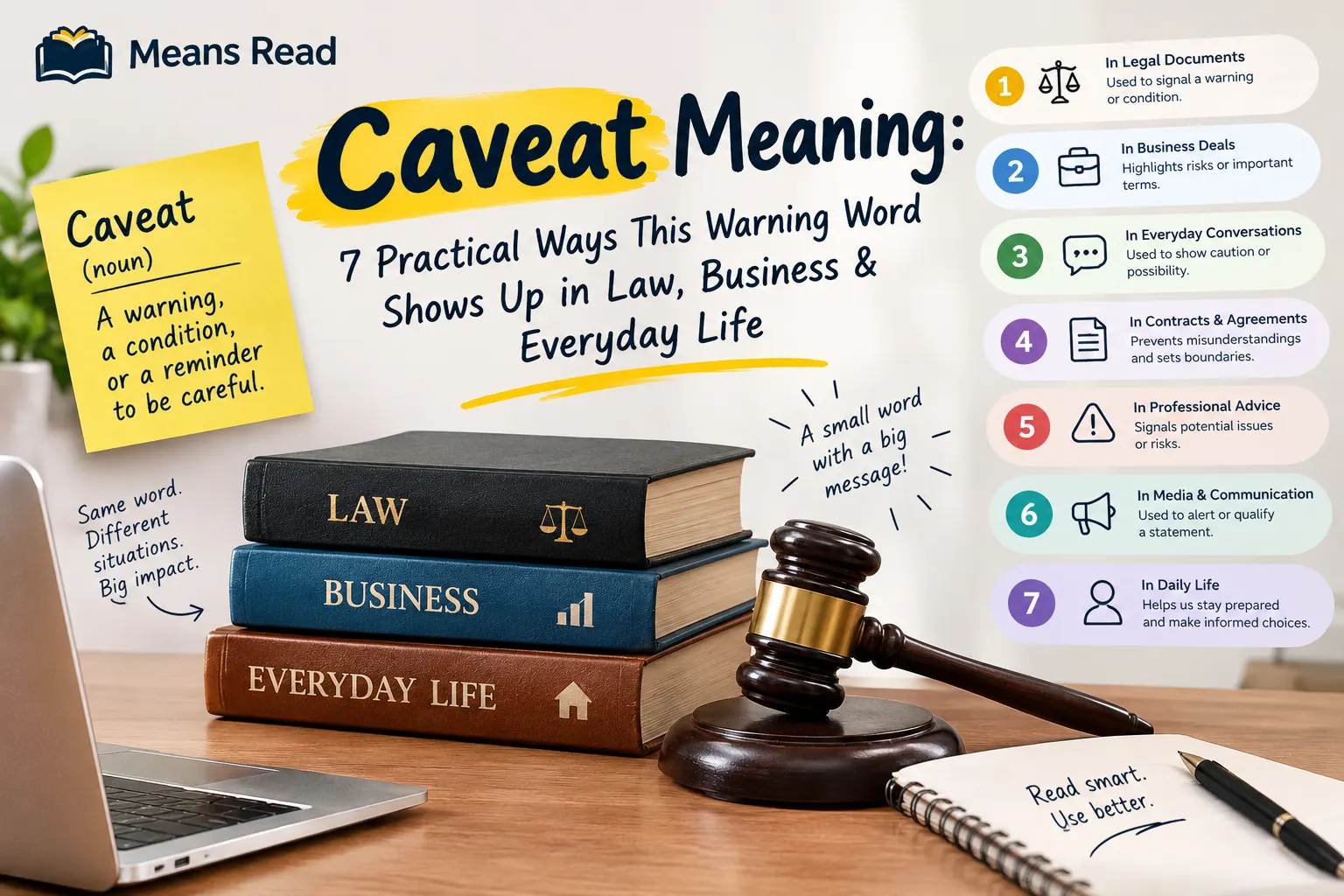
Caveat meaning is straightforward once you hear it in context: it is a warning, a caution, or an important condition you should keep in mind before acting or accepting something at face value. Americans use the word constantly in conversation, contracts, investment advice, and court documents. When someone says “with one caveat,” they are flagging a limitation or risk that changes how you should interpret the rest of the statement.
The word comes from Latin caveat, meaning “let him beware.” That original sense of caution still drives every modern use, whether casual or highly formal.
This guide explains caveat meaning in English, walks through its legal and business applications in the United States, covers related phrases such as caveat emptor, and answers the secondary questions people actually search for—including translations and specialized legal contexts.
Caveat Meaning in Simple Everyday English
In ordinary American speech, a caveat is a qualification or heads-up. It softens a stronger claim or points out a potential problem.
Examples you will hear:
- “The product works great—with the caveat that battery life drops in cold weather.”
- “I’ll support the plan, with one caveat: we need better data first.”
- “The study looks promising, but there are important caveats about sample size.”
Here the speaker is not rejecting the idea. They are adding a necessary condition or warning so the listener does not misunderstand or get burned later. In this sense, caveat meaning in English is simply “a caution you should remember.”
Caveat Meaning in Law
In American legal practice, caveat meaning in law takes on a more formal role. A caveat is a written notice filed with a court or judicial officer asking that a particular proceeding be paused until the person who filed the notice (the caveator) has a chance to be heard.
Common settings include:
- Probate courts, where someone files a caveat to stop or delay the proving of a will until their claim or objection can be considered.
- Certain specialized proceedings where an interested party wants formal notice before any order is entered against them.
The underlying idea remains the same as the everyday meaning: “Wait—there is something the court needs to hear before moving forward.” Filing a caveat does not automatically win the case. It simply protects the right to be notified and heard before certain actions occur.
Related legal phrases Americans encounter:
- Caveat emptor — “Let the buyer beware.” This long-standing doctrine places responsibility on the purchaser to inspect goods or property before buying. While modern consumer-protection laws have limited pure caveat emptor in many retail settings, the principle still appears in private sales, certain real-estate transactions, and “as-is” contracts.
- Caveat lector — “Let the reader beware,” a lighter warning sometimes used about published material.
Caveat Meaning in Property Law
Caveat meaning in property law varies by jurisdiction. In the United States the closest everyday equivalent is often a lis pendens (notice of pending litigation) recorded against real property. That notice alerts potential buyers and lenders that a lawsuit affecting the title is underway.
In some other common-law systems (notably Australia and parts of Canada), a “caveat” itself is registered directly on the land title. It acts as a formal stop-sign: the registered owner generally cannot transfer or further encumber the property without dealing with the caveator’s claimed interest. American readers researching international property or cross-border deals sometimes encounter this usage and need to understand it is more title-specific than the U.S. probate-style caveat.
In both systems the purpose is protective: it prevents dealings that could prejudice a claimed interest until the claim is resolved or the caveat is withdrawn or removed by court order.
Caveat Meaning in Business
In business and finance, caveat meaning in business almost always signals risk disclosure or contractual limitation. Investment summaries, earnings calls, product launches, and consulting reports regularly include caveats so that statements are not taken as absolute guarantees.
Typical examples:
- An analyst report ends with caveats about market volatility or incomplete data.
- A software vendor’s proposal includes the caveat that performance depends on the client’s existing infrastructure.
- A merger announcement carries caveats about regulatory approval and integration risks.
These caveats serve two purposes. They manage expectations and they provide a measure of legal protection if later results fall short of optimistic projections. In contracts, carefully worded caveats and disclaimers help define the boundaries of liability.
Caveat Meaning Slang and Informal Use
Outside formal settings, Americans sometimes treat “caveat” almost like slang for any quick warning or condition. A friend might text “I’ll go, caveat: I have to leave by 9.” In online discussions someone might write “Great idea, big caveat though…” The tone is conversational rather than legalistic, but the core idea of a limiting condition remains intact.
Trial Caveat Meaning
Searches for trial caveat meaning usually point to the procedural device used before or during civil proceedings. A party who anticipates that the other side may seek an interim order (such as a temporary injunction or stay) can file a caveat so the court cannot grant that relief without first giving notice and an opportunity to be heard. In some jurisdictions this is explicitly authorized by civil-procedure rules. The filing protects against surprise ex-parte orders and forces the opposing party to serve the caveator before the court acts.
Caveat Meaning in the Bible
The word “caveat” itself does not appear as a biblical term. It is Latin legal vocabulary that entered English centuries after the biblical texts were written. Some readers look for spiritual or moral parallels to the idea of caution (“let the buyer beware,” or more broadly, wise discernment), but there is no direct scriptural use of the Latin phrase. The concept of prudent caution appears throughout wisdom literature, yet the specific legal and commercial term “caveat” is post-biblical.
Caveat Meaning in Hindi and Farsi
For bilingual readers:
- Caveat meaning in Hindi is commonly rendered as चेतावनी (chetāvnī – warning), सावधानी (sāvadhānī – caution), or in formal legal contexts इत्तलानामा (ittalānāmā – notice). “Caveat emptor” is often explained as क्रेता सावधान (kretā sāvadhān – buyer beware).
- In Farsi, approximate equivalents include هشدار (hoshdār – warning) or احتیاط (ehtiyāt – caution/precaution). Legal or formal contexts may use more specific phrasing depending on the exact procedural meaning intended.
These are practical translations for everyday understanding; official legal documents in either language use precise terminology that should be checked with a qualified translator or attorney.
How to Use the Word Naturally
Americans most often introduce a caveat with phrases such as:
- “with the caveat that…”
- “one important caveat is…”
- “the main caveat here is…”
- “subject to the following caveats…”
In writing, placing the caveat early prevents readers from forming an incomplete impression. In speech, a brief pause before the caveat helps the listener register that a condition is coming.
Read More:
TLDR Meaning
Antebellum Meaning
TMP Meaning
What Does HN Mean in Text?
Skink Meaning
Naive Meaning
Platonic Meaning
Pedantic Meaning
Why the Word Still Matters
Whether in a casual conversation, a business proposal, a real-estate contract, or a probate filing, a caveat forces attention onto risk, limitation, or the need for further process. It is a linguistic tool that slows people down just enough to consider what might go wrong or what still needs to be resolved. Understanding caveat meaning across its everyday, legal, and commercial uses helps you both issue clear warnings and recognize when someone is protecting their position with a formal notice.
