
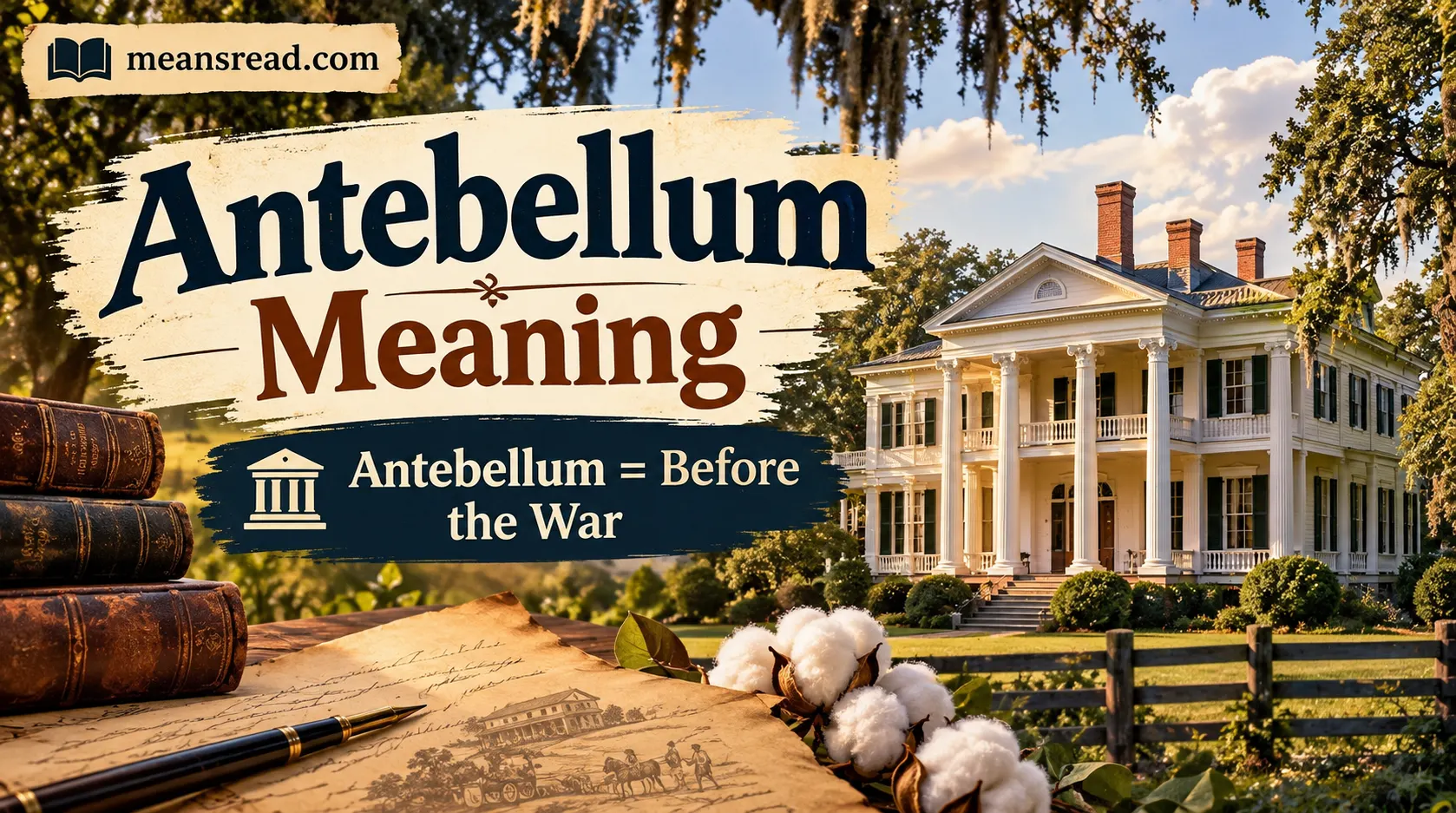
Antebellum Meaning “before the war.” In everyday American English, it almost always refers to the period in the United States before the Civil War (roughly 1815–1861), especially the culture, economy, and architecture of the Southern states.
What Does Antebellum Mean Exactly?
The word comes from Latin: ante (“before”) + bellum (“war”).
- Literal meaning: Existing or occurring before a war.
- Most common American usage: Belonging to the decades before the American Civil War, particularly in the South.
You will see it used as an adjective before nouns:
- antebellum South
- antebellum plantation
- antebellum architecture
- antebellum period / era
Simple Meaning of Antebellum
In plain terms, antebellum describes anything connected to the American South in the years leading up to 1861—grand columned houses, cotton plantations, a society built on enslaved labor, and the growing political tensions that eventually led to war.
The Antebellum Period in American History
Historians generally date the antebellum era from the end of the War of 1812 (around 1815) to the start of the Civil War in 1861. Key features of this time included:
- Rapid westward expansion and the idea of Manifest Destiny
- The rise of the cotton economy in the South, made more profitable by the cotton gin
- Deepening dependence on enslaved labor
- Industrial growth and reform movements in the North
- Political compromises (Missouri Compromise, Compromise of 1850, Kansas-Nebraska Act) that tried—and ultimately failed—to manage the slavery question
The term is most strongly linked to the Antebellum South, a society organized around large plantations and a rigid racial hierarchy.
Antebellum Architecture and Culture
When people say “antebellum house” or “antebellum mansion,” they usually mean the distinctive Southern style of the period:
- Large homes with white columns
- Wide porches (verandas)
- Symmetrical designs influenced by Greek Revival and classical architecture
These buildings are often preserved today as historic sites, though the romanticized image of them (popularized by books and films such as Gone with the Wind) has long been criticized for glossing over the reality of slavery.
Antebellum Meaning in Law
In legal contexts, “antebellum” simply marks a time period. It appears in discussions of:
- Property and land ownership records from before the Civil War
- Inheritance and estate matters tied to pre-war holdings
- Historical analysis of slavery-related laws, the Fugitive Slave Acts, and early civil-rights questions
It is not a formal legal doctrine but a chronological label used by historians and lawyers.
Lady Antebellum Meaning and the Name Change
The country music group originally named Lady Antebellum chose the name in 2006 after taking early band photos in front of a Southern-style house. In June 2020, during widespread protests against racial injustice, the band announced it was dropping “Antebellum” and would be known as Lady A.
They explained that they had not fully considered the word’s strong association with the pre-Civil War South and the institution of slavery. The change reflected a broader public re-examination of language and symbols linked to that era.
Common Misconceptions
- It does not only mean “old Southern houses.” While architecture is a frequent association, the word properly refers to the entire historical period.
- It is not limited to the South. Technically it can describe any pre-war period, but in U.S. usage the Civil War context dominates.
- It is not neutral for everyone. For many, the term carries the weight of a society built on human bondage, which is why some institutions and brands have moved away from it.
Related Terms
| Term | Meaning | Time Frame |
|---|---|---|
| Antebellum | Before the war | ~1815–1861 |
| Postbellum | After the war | 1865 onward |
| Reconstruction | Rebuilding period after the Civil War | 1865–1877 |
| Civil War era | The war years themselves | 1861–1865 |
Quick Summary
Antebellum = before the war, especially before the American Civil War.
It describes a specific time, place, and culture in U.S. history—the Southern states in the decades leading up to 1861. Understanding the word requires knowing both its literal Latin roots and the complex, often painful historical reality it points to.
Read More:
